

Nonhyeon Skin Care: Why a Decline in Skin Elasticity Is Linked to Changes in Collagen
2026/06/12
- KO-한국어
- |
- 슈링크유니버스
When I conduct elasticity consultations in the clinic, I come across an interesting common thread
more people than you might expect bring up changes in their facial lines before they mention wrinkles.
“It feels like my cheeks have drooped downward.”
“My jawline seems blurrier than it used to be.”
“My skin looks like it’s gotten thinner.”
In fact, the change people first notice when they look in the mirror is, more often than deep wrinkles, the contour of the face or the overall impression of the skin.
I don’t view these changes as simply a matter of age. I think it’s more appropriate to understand them as changes that emerge as the environment supporting the skin gradually shifts.
Today, from the perspective of Nonhyeon skin care, I’d like to look at the relationship between skin elasticity and collagen, and talk about how SHURINK UNIVERSE — which has been drawing growing interest lately — approaches the matter.
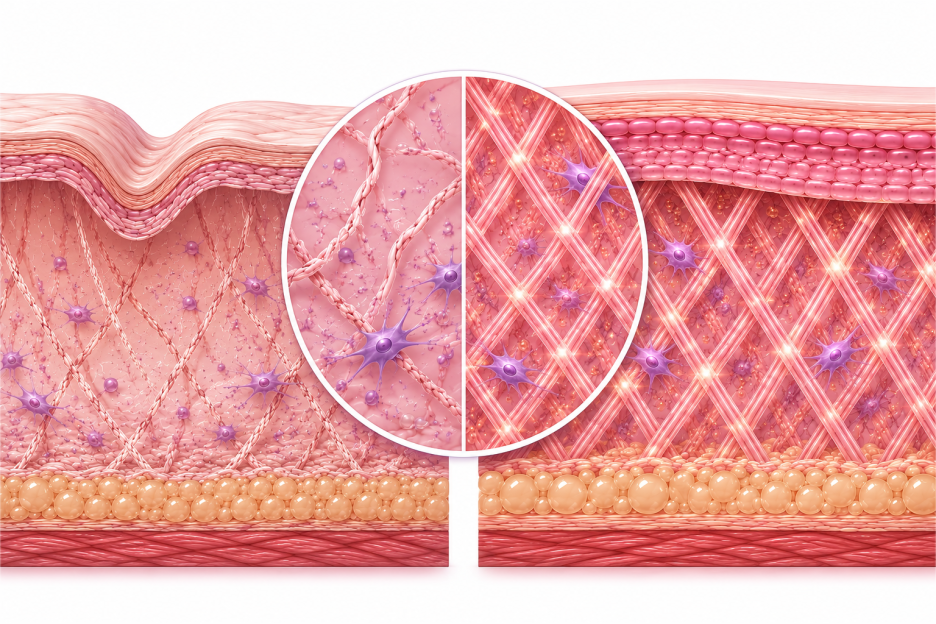
The Collagen Network Within the Dermis
I often compare collagen to a mesh-like structure within the skin.
A densely connected mesh supports the internal tissue and plays the role of maintaining the skin’s form. But as time passes, once that mesh loosens or its supporting strength weakens, the power to maintain form can gradually diminish as well.
Skin is much the same.
Collagen is one of the important elements that maintains the skin’s form and underpins its elasticity, but as time goes on, the amount produced naturally decreases. When factors such as UV exposure, lack of sleep, and lifestyle habits are added on top of this, the strength supporting the skin can grow weaker bit by bit.
As a result, the skin becomes more susceptible to the effects of gravity, which leads to changes in facial lines and a decline in elasticity.
In fact, I frequently see cases where there’s a significant difference in skin condition even among people of the same age group.
For example, those who do a lot of outdoor activity or are frequently exposed to UV rays sometimes see a faster decline in elasticity; conversely, those who have consistently kept up with sun protection and lifestyle management can be seen maintaining a relatively stable skin condition.
Also, after the age of 40, it’s not uncommon for people to bring up concerns about sagging in the mid-cheek area or changes in the jawline before they mention fine lines.
I don’t think these differences are simply due to age. That’s because one’s everyday environment and skincare habits also exert no small influence.
Changes in collagen can bring about a variety of skin changes beyond a decline in elasticity.
In fact, as I carry out consultations, there are also those who first complain of dryness or changes in skin tone rather than sagging. This is because, when the environment supporting the skin changes, it can lead to a rougher-looking texture or an impression of lacking vitality.
That’s why I think it’s important to understand skin aging not simply as a single issue of wrinkles, but as a change in the overall balance of the skin.
Recently, for the reasons above, more people are taking an interest in the skin’s internal environment rather than its surface.
In Nonhyeon skin care consultations as well, I’m often asked whether a condition can be managed with cosmetics alone, or whether the skin condition needs to be examined from more diverse angles. One of the devices mentioned in this process is SHURINK UNIVERSE.
When I’m in an elasticity consultation in the clinic, I’m often asked, “Which device is the best?”
But before the name of a device, I think the process of checking the current skin condition is what matters. That’s because a decline in elasticity, in most cases, appears not at the skin’s surface but alongside changes in the layer that supports the skin.
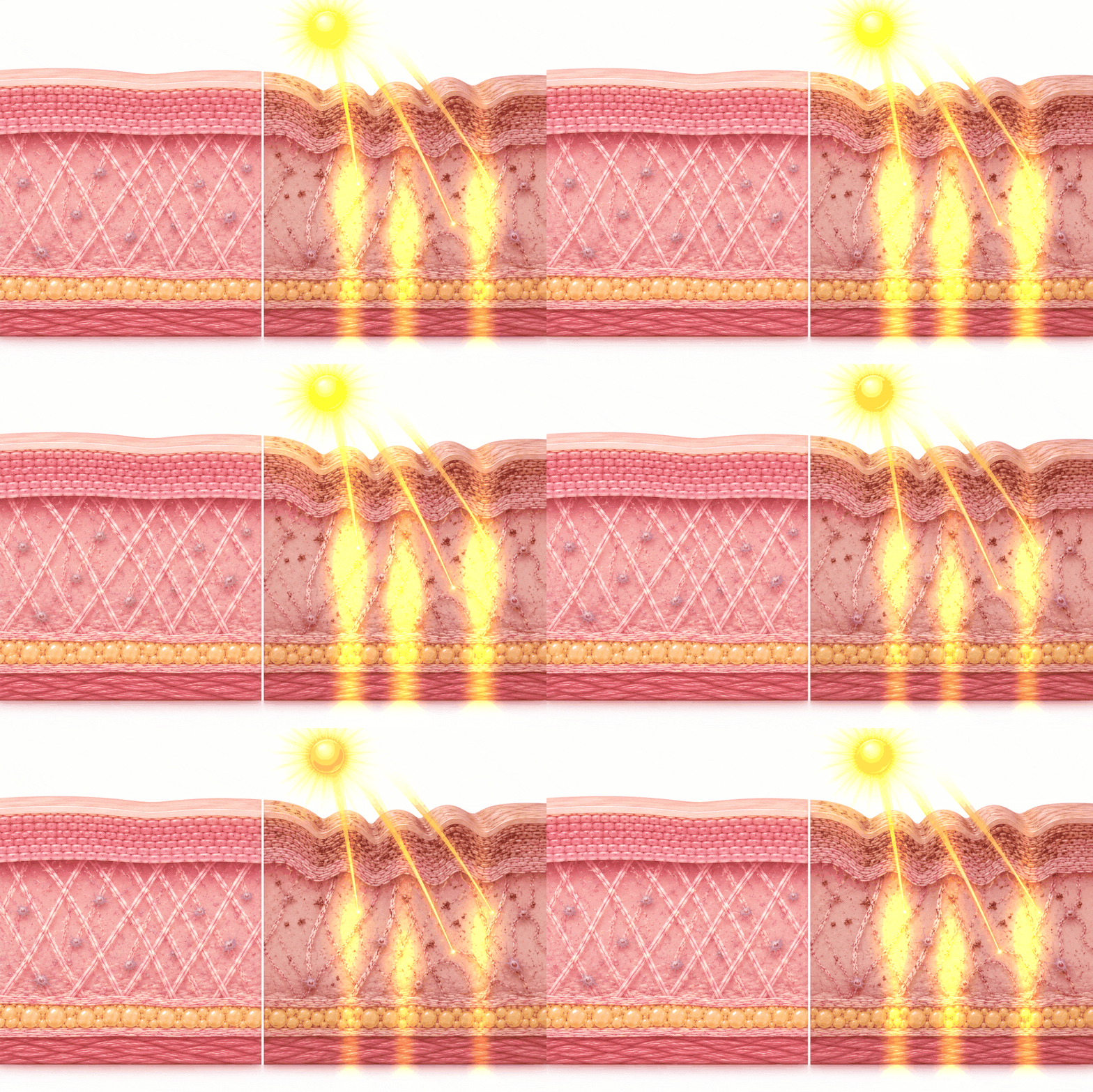
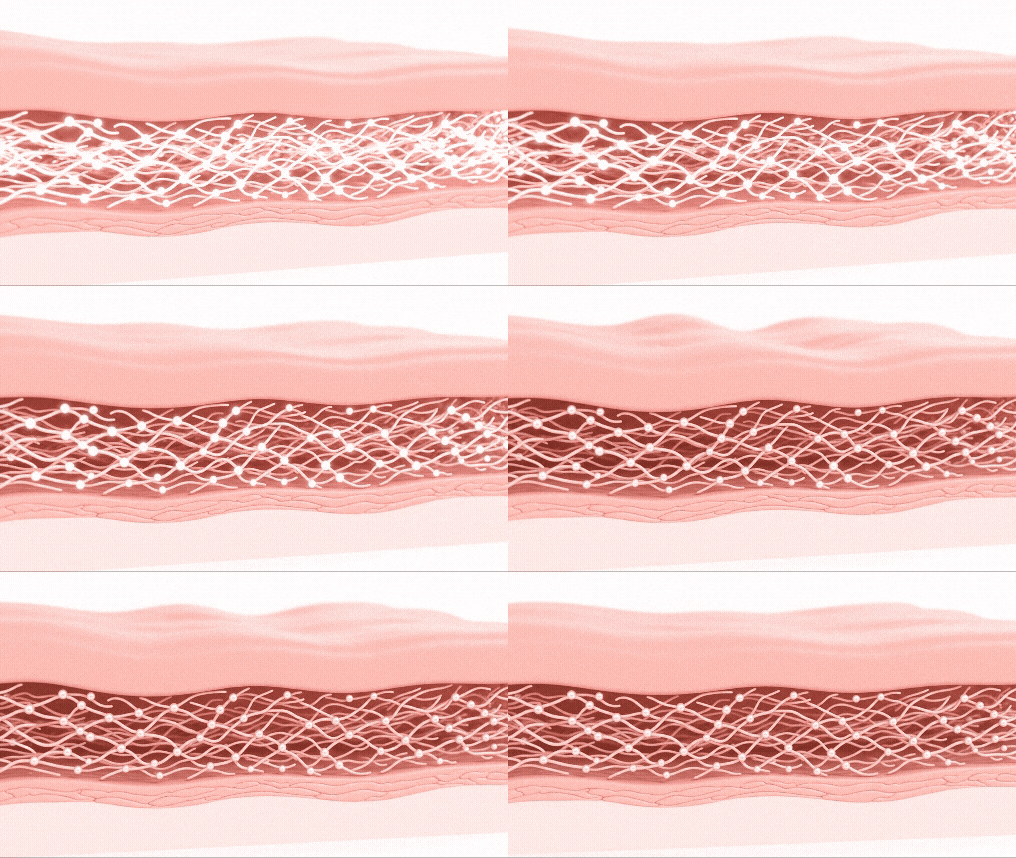
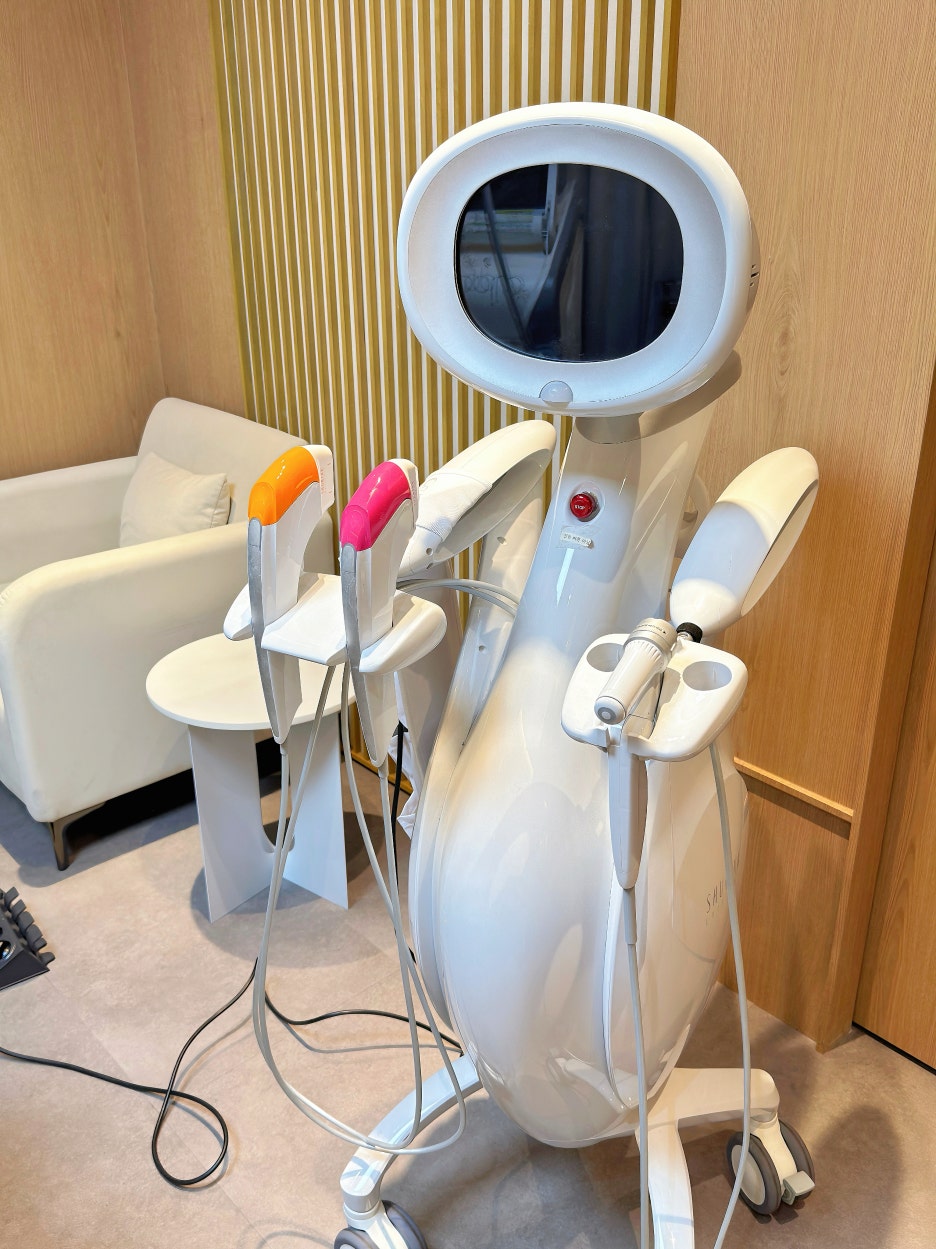
SHURINK UNIVERSE
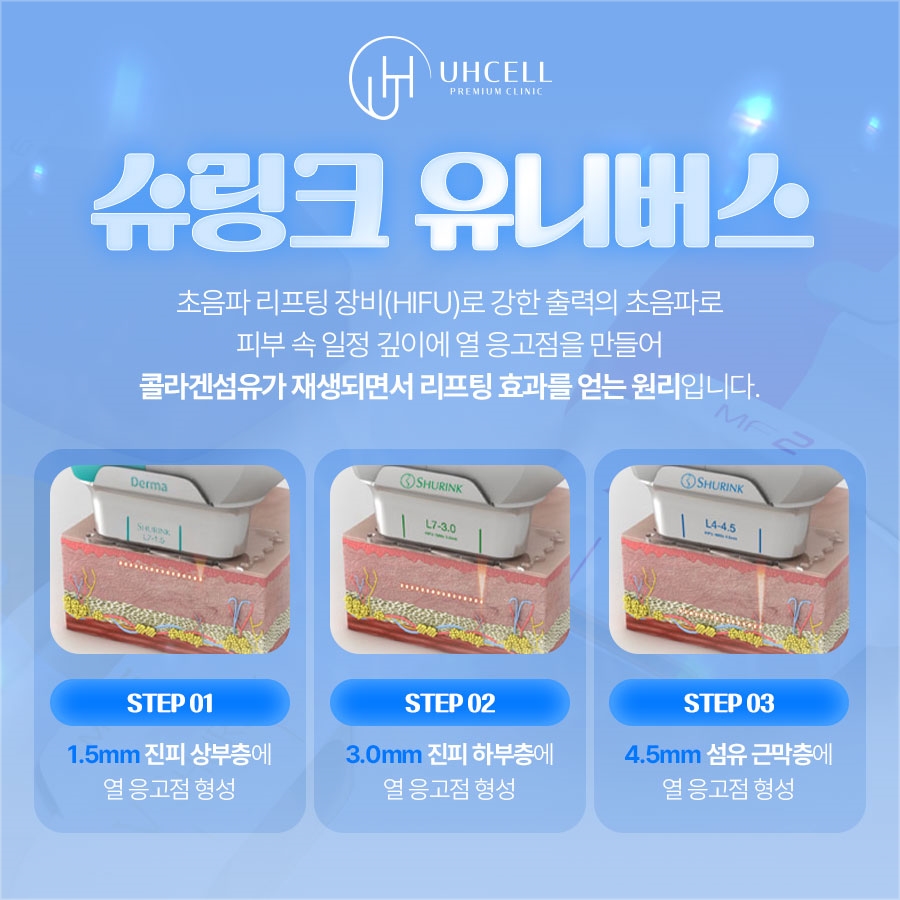
This is precisely why ultrasound lifting devices have lately been focusing on a specific depth rather than the skin’s surface.
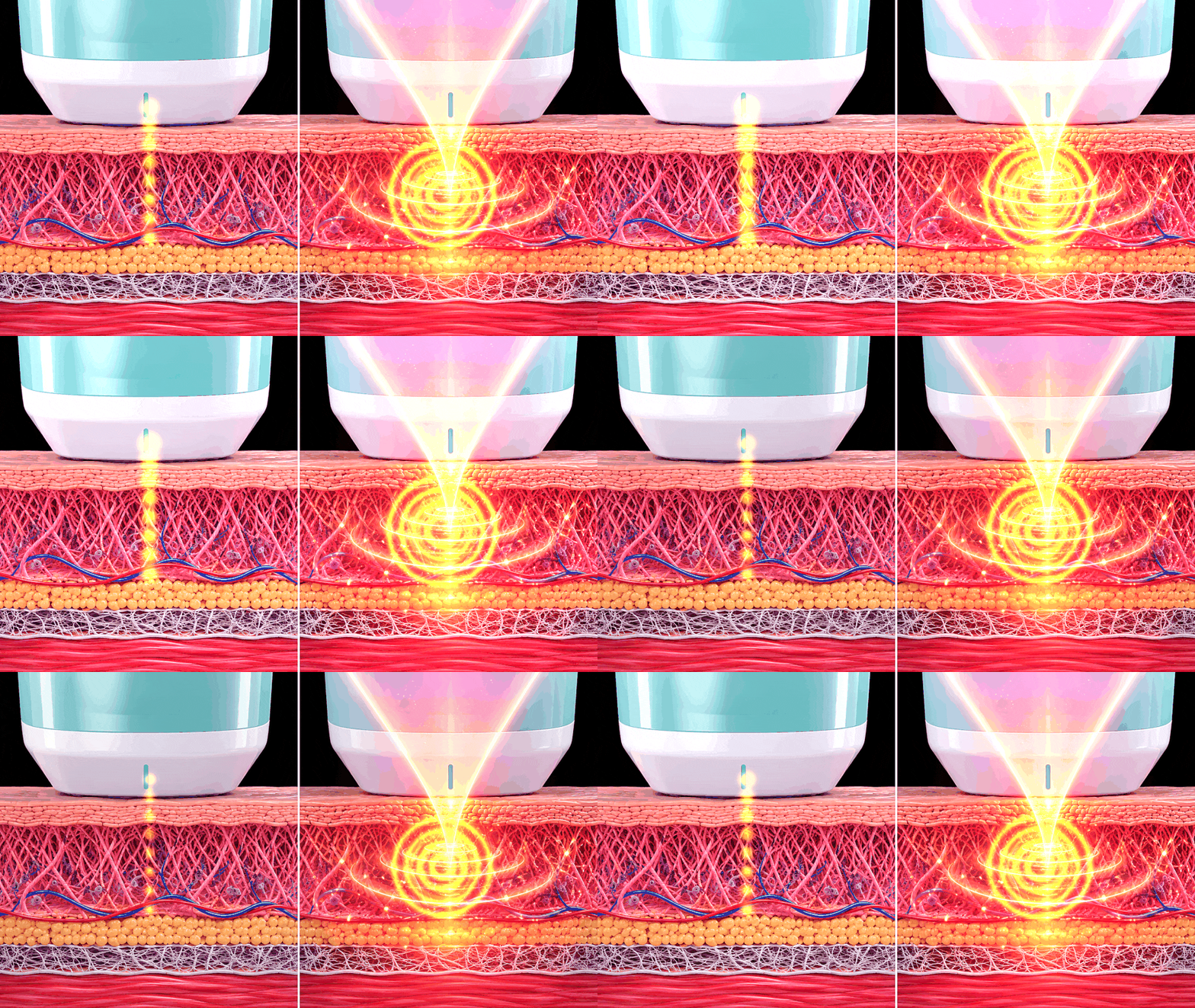
SHURINK UNIVERSE likewise uses high-intensity focused ultrasound (HIFU) to deliver energy to a target layer within the skin. Rather than affecting the entire surface of the skin, you can understand it as the concept of delivering energy to the depth where it’s needed. What I find meaningful about SHURINK UNIVERSE is precisely that it’s a device that focuses on the layer supporting the skin rather than the skin’s surface.
That said, what’s important here is the method of application rather than the device itself.
Some people occasionally wonder whether using stronger energy might produce better results. But in many cases, how accurately the current skin condition has been assessed plays a more important role.
Skin thickness and the distribution of the fat layer differ from person to person, and the pattern in which aging progresses is not the same for everyone either. Just as, for some people, a decline in elasticity is central, while for others, a loss of volume appears first.
So even when the same device is used, the approach ends up differing. An area where the skin is thin, like around the eyes, and an area heavily influenced by the fat layer, like the jawline, differ in the very depth and direction of approach that must be considered.
The most important factor in elasticity management is balance.
That’s because you have to examine, together:
- which layer should be considered
- which area should be focused on
- what the current skin condition is like
Nonhyeon skin care, likewise, should be preceded by the process of understanding what state the skin is currently in, rather than making judgments based on a particular device.
Skin elasticity does not collapse all of a sudden one day. The decline of collagen, too, is not a change that progresses overnight.
So if changes have begun to become visible, rather than looking only at the changes appearing on the skin’s surface, it’s important to also examine what changes are occurring in the environment that supports the skin.
If you understand what process your skin is currently going through as it changes, it can help you set a more appropriate direction for care.
Thank you for reading this long piece today as well. This has been Kim Yeon-jin, Head Director of UHCELL Clinic Gangnam.
📍 UHCELL Clinic Gangnam — Lifting Center: 2nd & 3rd Floor, WD Building, 13, Teheran-ro 8-gil, Gangnam-gu, Seoul
📍 UHCELL Clinic Gangnam — Anti-aging Center: 2nd Floor, UH FLAT GANGNAM Hotel, 11, Teheran-ro 10-gil, Gangnam-gu, Seoul
📞 02-6941-0375