

UHCELL Gangnam, Yeoksam: Understanding the Principles Behind Lifting and Skin Firming
2026/04/30
- news
- |
- Ultherapy Lifting

Understanding the Principles Behind Yeoksam Lifting and Skin Firming
Hello, I’m Kim Yeon-jin, Director of the UH CELL Gangnam Branch.
“Doctor, my jawline isn’t what it used to be.” “I feel like my facial contours have become blurred, and it’s stressing me out.”
These changes are often more than just superficial skin issues, but rather the result of gradual, cumulative changes in the overall skin structure. Today, I’d like to take a closer look at the newly introduced Ultherapy Prime, explaining the principles behind lifting and improving skin elasticity and firmness.
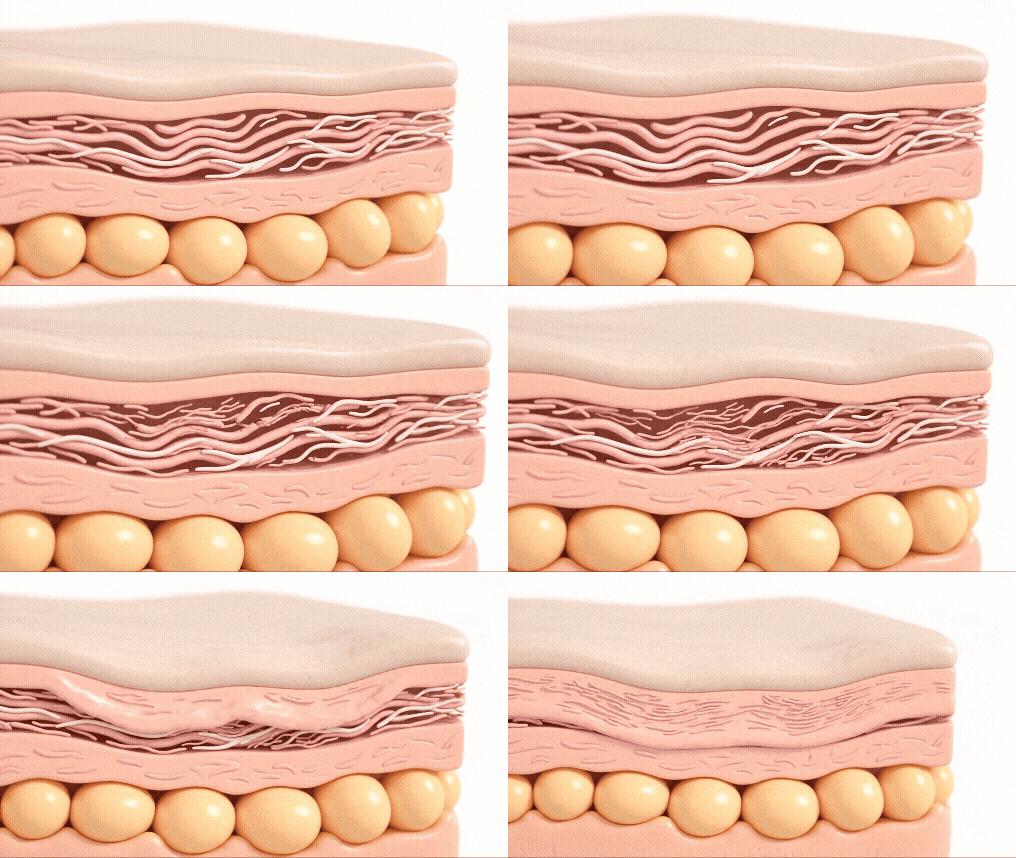
Where Does Loss of Elasticity Begin?
Skin elasticity cannot be explained solely as a surface-level issue. The skin consists of the epidermis, dermis, subcutaneous tissue, and the SMAS layer. Among these, the dermis—where collagen and elastin are found—and the superficial musculoaponeurotic system (SMAS) play a crucial role in maintaining elasticity.
As time passes and these structures gradually loosen, the jawline becomes less defined, the cheeks begin to sag, and the overall facial contours lose their definition. Therefore, lifting is not simply about pulling the skin tighten. Instead, it is important to focus on how to stimulate and restore the structures in the deep layers of the skin.

How Ultrasound Energy Works
One of the methods widely used in lifting is High-Intensity Focused Ultrasound (HIFU). It works by concentrating energy at a specific depth to form thermal coagulation points.
There are two main changes that can be expected from this process. The first is an immediate contraction response, where the tissue contracts slightly due to thermal stimulation. The second is delayed collagen regeneration, which induces the formation of new collagen over a period of time.
However, since the response may vary depending on an individual’s skin thickness and degree of sagging, a personalized treatment plan should be established rather than a one-size-fits-all approach.
Ulthera Prime: Differences from Previous Models
One of the devices currently in use is the Ultherapy Prime. The most noticeable differences compared to the original Ultherapy are visualization and precision. The ultrasound image resolution has been improved, and the display is larger, allowing for real-time visualization of the skin layers.
This allows the practitioner to examine the internal skin structure more thoroughly, minimizing unnecessary stimulation and delivering energy only to the necessary layers. The key to the lifting process is delivering energy to the precise depth, and advancements in equipment often translate into a noticeable difference in the actual results.
Changes in the Approach to Pain and Recovery
While it was common in the past to apply the same energy level consistently, recent methods utilize real-time intensity adjustment. Ultherapy Prime, for example, features a system that allows for adjustments based on skin thickness, sensitivity by area, and elasticity.
Actual results may vary depending on individual conditions, so it is important to prioritize thorough consultation and understanding rather than having excessive expectations.
The key to a successful lifting is the treatment plan
While many people focus on the device itself, the actual outcome is greatly influenced by which areas are targeted and how the face is divided and approached. The treatment plan can vary significantly depending on the individual’s facial structure and specific concerns—whether the focus is on the jawline, sagging cheeks, or redistributing volume from the lower cheeks to the cheekbones.
Lifting is not a treatment that should performed in exactly same way in everytime. Rather, it is a process of analyzing the individual’s facial structure and designing a treatment approach accordingly.
Factors to Consider Before Choosing a Treatment
If you are considering a lifting, it is advisable to examine the following factors: the underlying cause of your current loss of elasticity, the thickness of your skin and the condition of your tissue, the desired direction and extent of change, and how to establish a treatment schedule and aftercare plan.
In particular, rather than attempting to resolve all issues with a single treatment, it is more advisable to approach it as part of an overall skin condition management plan. Lifting is not simply about changing your appearance. It is better understood as a process of assessing how your facial tissues and skin change over time and developing an appropriate approach accordingly.
Advances in device such as Ultherapy Prime are certainly promising, what ultimately matters is the process of accurately assessing your current skin condition and developing a tailored plan. If you are aiming for gradual, balanced changes, I recommend approaching the process with caution, based on thorough consultation and understanding, rather than holding excessive expectations.
Even after treatment, maintaining basic skincare routines—such as sun protection and moisturization—can help maintain positive results. Among the various options available, the most important factor is finding what works best for you. I will continue to share practical and helpful information based on my clinical experience.
Thank you for reading this lengthy post.
— Kim Yeon-jin, Director, UH CELL Gangnam Branch
📍 Lifting Center: 2nd & 3rd Floors, WD Building, 13 Teheran-ro 8-gil, Gangnam-gu, Seoul 📍 Anti-Aging Center: 2nd Floor, UH FLAT GANGNAM Hotel, 11 Teheran-ro 10-gil, Gangnam-gu, Seoul 📞 02-6941-0375 🔗 www.uhcell.com
Source – https://blog.naver.com/doctorpetit_gn/224268887603